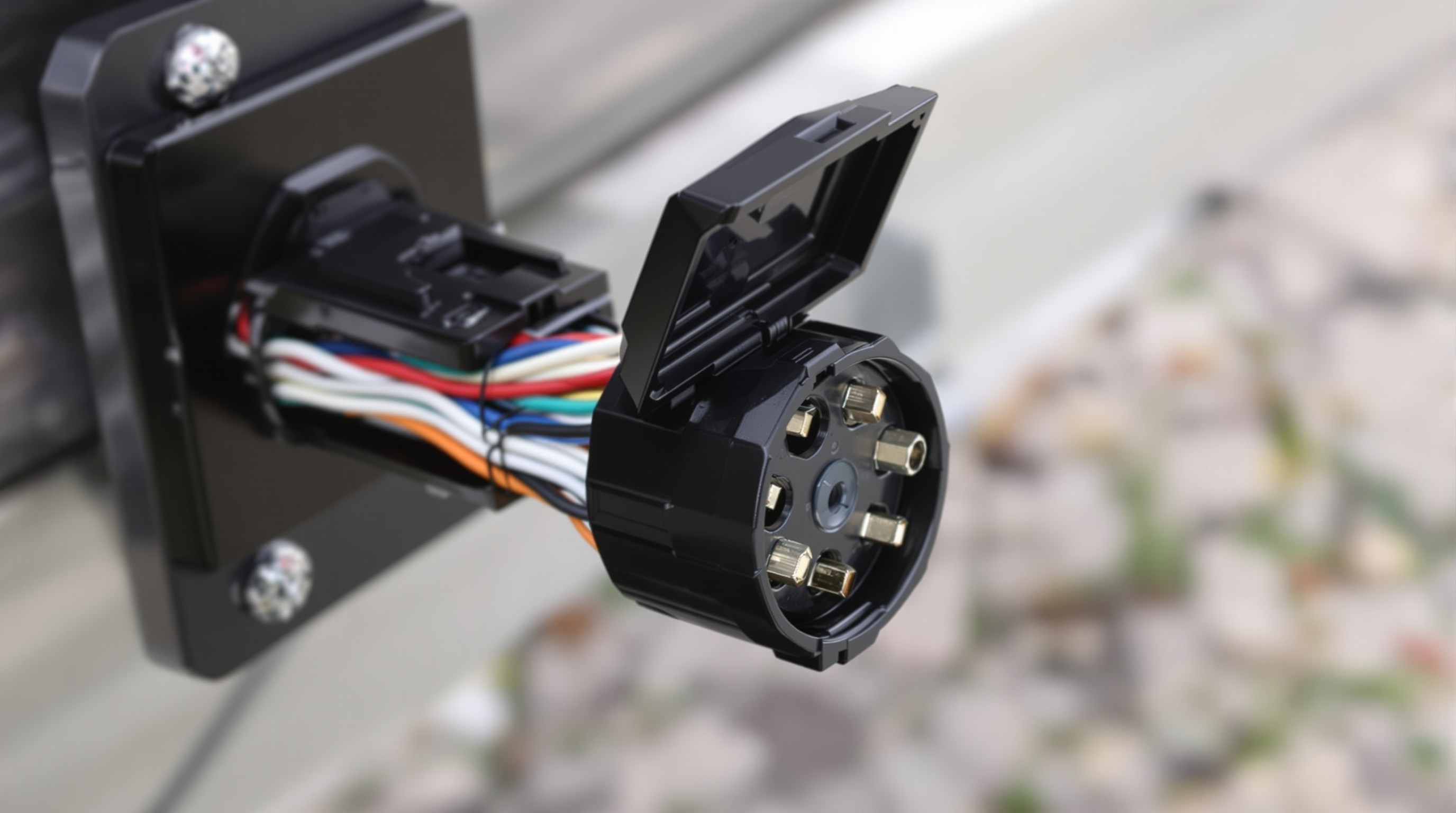
Trailer wiring is its own small world of connector standards. A trailer cord links the tow vehicle's electrical system to the trailer's lights and, on larger rigs, its brakes and battery. The number of functions the trailer needs determines which connector configuration you use — from a simple 4-way flat to the 7-way RV blade found on most modern tow vehicles.
The Common Configurations
- 4-way flat — the basic set: ground, tail/running lights, left turn/brake, right turn/brake. Standard on small utility trailers and boat trailers.
- 5-way flat — adds a fifth wire, typically for hydraulic surge-brake reverse lockout or an auxiliary function.
- 6-way round — adds circuits for electric brakes and a 12 V auxiliary/battery feed; common on livestock and mid-size trailers.
- 7-way RV blade — the full set: running lights, left turn, right turn, electric brakes, reverse, 12 V battery charge and ground. Standard on RVs and larger utility/car trailers.
Wire Color Conventions
North American trailer wiring follows a widely used color code that makes connections predictable:
- White — ground
- Brown — tail/running lights
- Yellow — left turn and brake
- Green — right turn and brake
- Blue — electric brakes
- Black — 12 V battery/auxiliary
These are conventions rather than a single legal mandate, so verifying with a circuit tester before towing is always wise.
Construction and Durability
Trailer cords live outdoors, so jacket and connector choice matter. Cords use weather- and oil-resistant insulation (see cord types such as SOOW), and quality connectors add sealed, corrosion-resistant terminals with spring-loaded covers. A robust strain relief at the plug keeps road vibration and yanking from breaking the conductors. Coiled cords are popular because they retract out of the way and resist dragging.
Working at Hitch Height
A trailer connection sits low enough to invite bending and reaching, especially when the socket, safety hardware and cord are being handled in one sequence. Before working at the hitch, secure the tow vehicle and trailer against movement and make sure the area underfoot is clear. Stand close enough to avoid reaching with straight arms. Bending at the hips and knees, with the cord held near the body, gives better control than rounding the back while pulling a heavy or stiff cable toward the socket.
Visibility should be established before force is applied. Open the cover, identify the connector orientation and inspect the faces from a stable position; a small work light is more useful than twisting sideways to catch daylight. Align keyed features and push on the plug body, not the cord. If the connection does not seat normally, stop and check for dirt, corrosion, bent contacts or a mismatched pattern rather than rocking the plug with greater force. Keep fingers away from the cover's closing path as it returns over the seated connector.
Disconnecting deserves the same deliberate posture. Grip the connector body, move close to the hitch and use a controlled pull without jerking the cable. Support a long or coiled lead as it comes free so it cannot drop, rebound or become a trip point. Then stow it where the contacts stay protected and the cord cannot drag. None of these handling steps substitutes for the electrical checks: confirm the plug and socket pattern, protect the ground path, and test lighting and brake circuits before towing.
Safety and Compliance
Trailer lighting exists for safety, and functional turn, brake and tail signals are required for road-legal towing. Federal requirements for vehicle lighting are administered by the National Highway Traffic Safety Administration, and connector/lighting practices are informed by SAE standards. When wiring a trailer, match the connector to the tow vehicle's factory harness and confirm every circuit before the first tow.