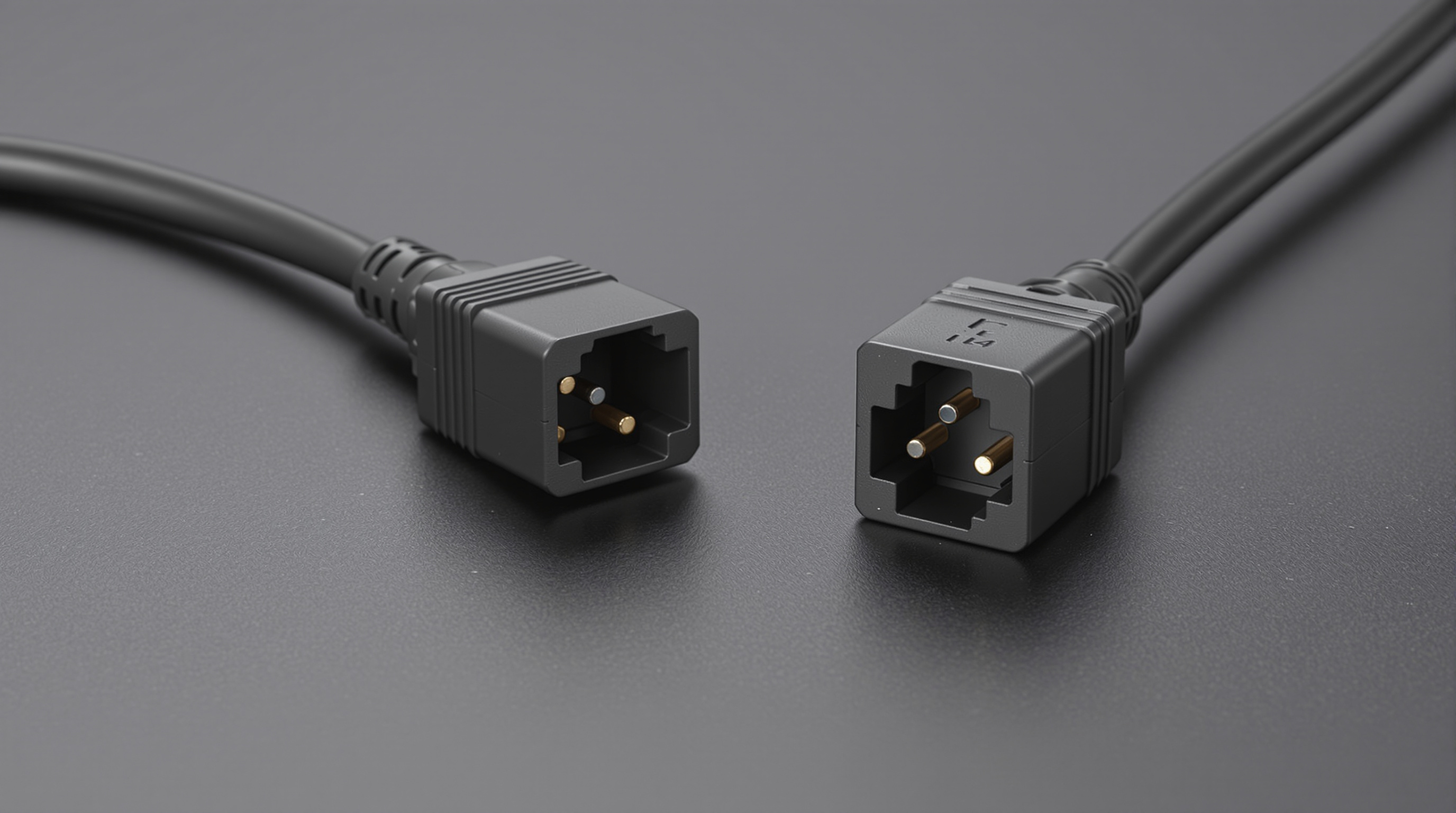
IEC 60320 — still widely called by its former number, IEC 320 — is the international standard that defines the small detachable connectors on the appliance end of a power cord. Because it is region-independent, IEC 60320 lets a single product ship worldwide: the appliance inlet stays the same while only the wall plug changes for each country. If you have ever unplugged the cord from the back of a desktop computer, you have handled an IEC 60320 coupler.
Connectors and Inlets: Odd and Even
Each IEC 60320 configuration comes as a matched pair. By convention, the connector (the female end on the cord) carries an odd C-number, and the mating inlet (the male appliance-mounted part) carries the next even number:
- C13 / C14 — the workhorse 10A pair on computers, monitors, servers, PDUs and lab equipment
- C7 / C8 — the small figure-8 (“shotgun”) 2.5A pair on radios, chargers and audio gear
- C5 / C6 — the three-contact “cloverleaf” or “Mickey Mouse” pair on laptop power supplies and projectors
- C19 / C20 — the larger 16A pair for high-draw servers, PDUs and data-center equipment
Temperature Ratings and the Notched Variants
Standard couplers are rated for a 70 °C operating environment. For hot conditions — kettles, some heaters, and equipment that runs warm — IEC 60320 defines notched, higher-temperature variants such as C15/C16 (120 °C, with a keyway that prevents mating with a standard C13 inlet) and C17/C18. The keying is deliberate: it stops a low-temperature cord from being fitted to a high-temperature appliance.
Cordset Construction
A typical IEC 60320 cordset combines a region-specific plug, an appropriately gauged flexible cord, and the C-connector — commonly over-molded with an integrated strain relief. Amperage must be consistent end to end: pairing a 10A C13 with undersized conductors defeats the rating. For the full standard, the International Electrotechnical Commission publishes IEC 60320, and North American versions are additionally listed to UL 60320 / CSA equivalents.