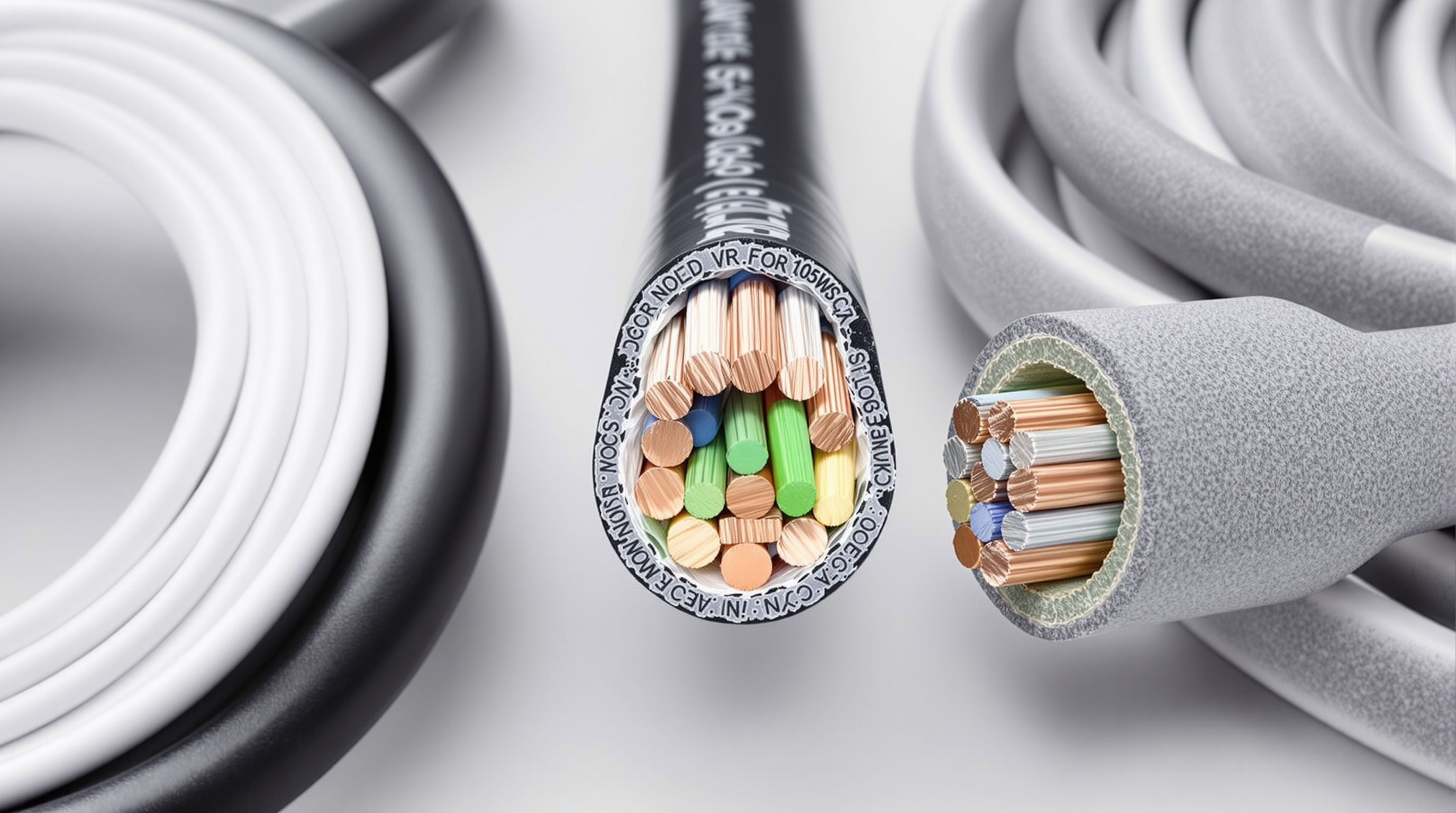
Every flexible cord is printed with a string of letters and numbers — SJT 16 AWG 3C, for example. Those codes are not decoration: they specify the insulation, the voltage class, the environmental resistance and the current capacity of the cord. Learning to read them is the fastest way to choose the right cord for a plug and load.
The UL Letter Codes
North American flexible cords are typed by a compact letter code defined in UL 62 and the National Electrical Code (Article 400). The key letters are:
- S — Service (600 V, hard usage)
- J — Junior service (300 V, lighter duty); its absence implies the full 600 V rating
- P — Parallel construction (as in SPT “zip” lamp cord)
- V — Vacuum-cleaner cord (light, in SVT)
- T — Thermoplastic (PVC) insulation
- O — Oil-resistant jacket (a second O, as in SOOW, means the insulation is oil-resistant too)
- W — Weather- and water-resistant, rated for outdoor use
So an SPT cord is light parallel lamp cord; SVT is a light thermoplastic appliance cord; SJT is a 300 V hard-service thermoplastic cord (the typical extension-cord jacket); and SOOW is a rugged 600 V oil- and weather-resistant rubber cord for shop and outdoor use.
Wire Gauge (AWG) and Ampacity
The number before “AWG” is the American Wire Gauge, and it runs backwards: a smaller number means a thicker conductor that carries more current. Common cord gauges and their rough general-purpose ratings are:
- 18 AWG — up to ~10 A, light appliances and electronics
- 16 AWG — up to ~13 A, general extension cords
- 14 AWG — up to ~15 A, heavier tools
- 12 AWG — up to ~20 A, high-draw equipment and long runs
Ampacity also depends on conductor count, insulation temperature rating and how the cord is bundled or coiled — a tightly coiled cord under load sheds heat poorly and must be derated.
Stiffness, Weight and the Workbench
Cords that meet the same electrical requirement can behave very differently during assembly. A light parallel cord lies flat and turns easily, while a larger round jacket or cold, oil-resistant compound may resist bending and spring away from a routing fixture. That stiffness changes how the work should be presented. Guides need a generous path that respects bend radius, and the entry to a connector should line up with the cord rather than relying on the assembler to hold a side load throughout termination.
Bundle weight matters too. Several long conductors hanging over the front of a bench can pull against a partly assembled connector, shift a strip position or make a careful insertion into a repeated gripping task. Supporting the free length on a smooth table extension, roller or height-matched cart keeps that weight off the termination point. The support should allow the cord to feed without snagging, sharp edges or a tight coil. For cut lengths, staging only the quantity needed for the next batch also keeps the immediate work area manageable.
Routing work is easier when bins, measuring marks and fixtures follow the direction the cord travels. Put the supply end where it can feed straight, keep hand tools inside a comfortable reach, and leave enough clear surface to turn the assembly without lifting the whole bundle. For heavier work, two-person handling or a simple lift aid may be more controlled than twisting to move the cord alone. These setup choices do not change ampacity or jacket selection; they help the chosen construction move through cutting, termination and inspection without adding avoidable force or awkward reach.
Conductor Count and Length
The “3C” (three-conductor) notation tells you the cord carries hot, neutral and ground — required for any grounded 5-15P cordset. Two-conductor cord suits double-insulated 1-15P devices. Finally, remember that voltage drop grows with length: a long run at a given gauge delivers less voltage to the load, so heavy or distant loads call for a thicker conductor than the plug rating alone would suggest.